Why I Still Start With a Camera

Updated: 11 hours ago
I bought an old wooden fan at a resale shop in Wickes as a gift for a friend. I still intend to give it to her. At the time, I simply thought it was unusual and beautiful - an object with more character than something new from a store shelf.
After bringing it home, I opened it across a faded chair and looked more closely.
The wooden slats were worn and uneven. Small holes ran through them, and faded drawings and markings covered the surface. The fan looked as though it had already lived a life before I found it.
I love butterflies. Once I noticed the resemblance, I could not stop seeing wings.
Looking Through a Camera
I did not buy the fan with a finished artwork in mind. The idea emerged later, while I was studying it at home.
Looking through a camera slows me down. It turns a passing impression into a series of decisions: where to stand, what to include, which details matter, and when the subject finally looks like what caught my attention in the first place.
The original photograph was not meant to stand alone as a polished artwork. The lighting was ordinary, the angle was imperfect, and the fan was resting on a chair. But the photograph recorded what made the object distinctive - its wood grain, worn edges, small holes, faded markings, and unusual construction.
Taking the picture was my way of saying: There is something here I do not want to lose.

The Creative Act of Noticing
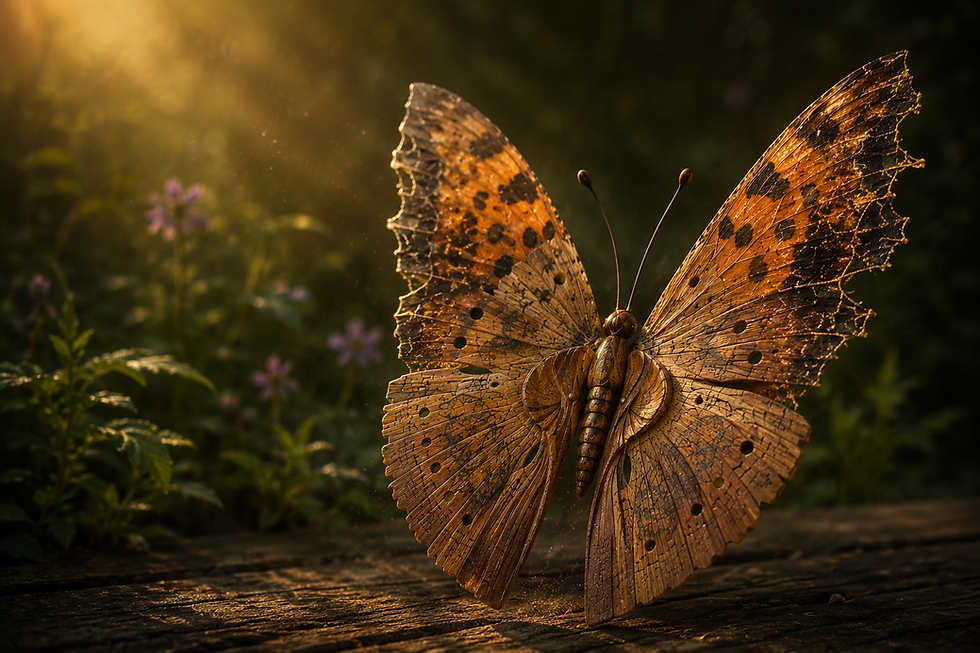
Its layered wooden slats resembled sections of wings, while the central hinge suggested the beginning of a body. The faded drawings and small holes looked like markings that might belong to an unusual species of butterfly.
Another person might have seen a flower, a costume, a piece of folk art, or simply an old fan. I saw wings because butterflies already occupied a place in my imagination.
That is an important part of making art: not only producing an image, but recognizing a possibility before the image exists.
Letting the Object Remain Itself
Some early interpretations tried to surround the fan with an entire story. They added references to Cuba, rural Arkansas, scenery, and signs. The results were interesting, but they explained the idea so thoroughly that the fan nearly disappeared inside the explanation.
The object did not need an invented landscape. Its shape was already the story.
A rusted background ultimately felt right because it belonged to the same weathered visual world as the wood. It supported the fan’s warmth, age, and texture without competing with them. Symmetry clarified the wings, and a body and antennae completed the transformation.
I did not want a perfect digital butterfly with flawless wings. I wanted this butterfly—one still carrying the scratches, drawings, holes, and uneven edges of the object from which it came.
Transformation did not require erasing the fan. It required deciding what the fan was allowed to become.
What AI Could Not Supply
AI-assisted tools helped me test visual possibilities. Some brought the idea closer; others carried it away from what I had seen.
The technology could help construct a butterfly, but it could not supply my reason for making this one. It could not connect the worn fan with my love of butterflies or recognize when an attractive interpretation was also the wrong one.
Those decisions came from the relationship between the object and the person looking at it.
AI helped me make the wings visible. It did not notice them hiding in the fan.
Making Room for Surprise
When I begin with a prompt, I ask for something already present in my mind. When I carry a camera into the world, I make room for something unexpected to interrupt me.
A garden changes with the weather. An old vehicle carries evidence of its working life. A rural building leans in a way no architect intended. An object in a resale shop can suggest an artwork I never planned to make.
That is why Farmstracts still begins with photography. A source photograph does not need to be technically perfect or conventionally beautiful. It needs to preserve the encounter - the moment when an ordinary subject becomes difficult to ignore.
The final artwork may travel far from the original scene, but it remains connected to something I actually found, handled, studied, and chose to remember.
The physical fan will continue its life as the gift I intended it to be. Its photograph gave rise to something separate: a butterfly carrying the history and character of the original wood.
The camera preserved what was there.
Imagination recognized the wings.