What Followed Me Home from the 2026 Queen Wilhelmina Rod Run

Updated: 11 hours ago
Two days of chrome, conversation, and creative discovery in Mena, Arkansas
By Reena Adair

By the second day of the Queen Wilhelmina Rod Run, I was standing on top of Rich Mountain showing people photographs of their own vehicles in places they had never been.
The day before, I had barely spoken to anyone.
Day One: Behind the Camera
The Rod Run began at Janssen Park in Mena, Arkansas. The park was filled with polished paint, exposed engines, unusual hood ornaments, and vehicles their owners had clearly poured themselves into.
I went looking for photographs for Chrome & Country, one of the collections I was building for Farmstracts. Chrome & Country still existed mostly in my imagination. I stayed behind my camera and quietly photographed whatever made me stop.
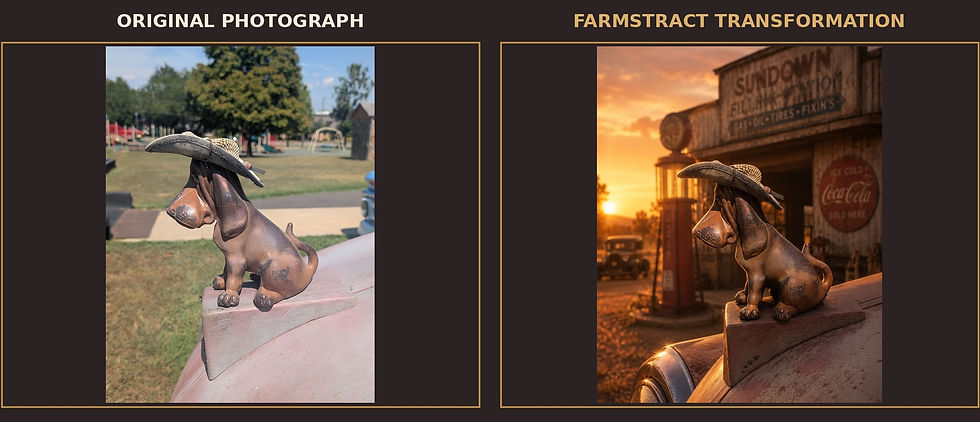
A weathered turquoise Chevrolet truck with a hillbilly license plate caught my attention. I began calling it Hillbilly Hearland. It looked as if it already had stories packed into its bed, and its Basset Hound hood ornament had enough personality for a portrait of its own.

When the Parking Spaces Disappeared
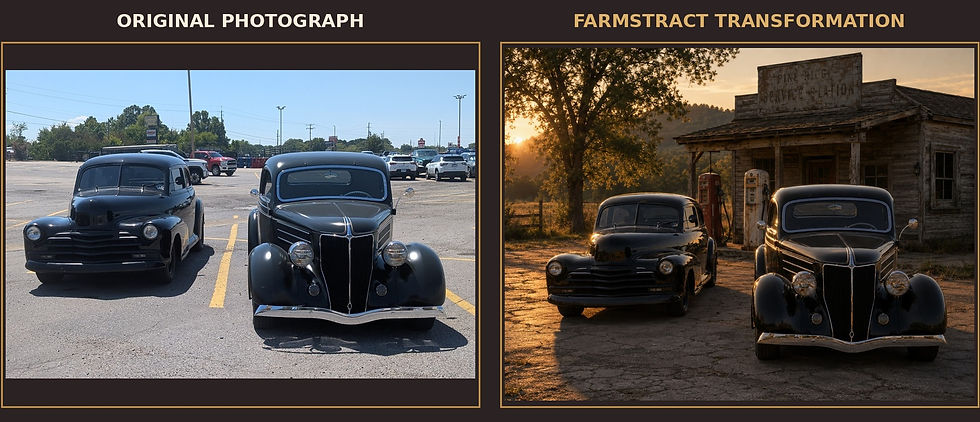
Back home, I let the showgrounds fall away. The truck took to a dirt road with dust rolling behind it. Roads, old buildings, and evening light began forming around the vehicles. The parking spaces disappeared, but their character remained.
These were not records of places the cars had actually traveled. They were my response to the humor, history, and motion I saw in the original photographs.
The Detail That Became a Story
The Basset Hound was a small part of a much larger truck, but it became one of my favorite photographs from the weekend. Once isolated from the crowd, that rusty little face seemed ready for a world of its own.
Day Two: Coming Out from Behind the Camera

The next day, the Rod Run moved to Queen Wilhelmina State Park atop Rich Mountain. I returned with the finished pictures on my phone and a small stack of Farmstracts cards with a QR code.
The website still was not open.
I arrived with a camera and an idea I had not yet tested.
Showing People What I Saw
I found the people connected with the turquoise truck I had nicknamed Hillbilly Heartland and showed them what their truck and Basset Hound had become.
I also found the owners of the two black vintage vehicles. Their cars had been sitting in an ordinary parking lot when I photographed them. On my screen, they were waiting outside an old filling station in the last light of day.
The Ones I Missed
I did not find everyone. The owners of the alligator rat rod, the number 74 hot rod, and the chrome hood ornament I later called Breaking the Speed Limit escaped me. I also photographed more vehicles on Day Two than I had time to ask about.
But every car mattered. So did every person who stopped to talk. These vehicles carried workmanship, memory, humor, and pieces of the people who built and cared for them. I appreciated all of them, including the ones whose owners I never met.
Breaking the Speed Limit
The chrome hood ornament was one of the photographs that stayed with me. I never met its owner, but the moment I saw it, that piece of metal was already flying.

What Followed Me Home
I went to the Rod Run because I needed to do something instead of continuing to talk about doing it. On Day One, I watched. On Day Two, I reached out.
Somewhere between Janssen Park and the top of Rich Mountain, Chrome & Country stopped being an idea. It became a collection shaped by real vehicles, real encounters, and the generosity of people willing to let me show them what I saw.
I arrived with a camera and a website that was not quite ready.
I left with stories, photographs, and proof that I was.