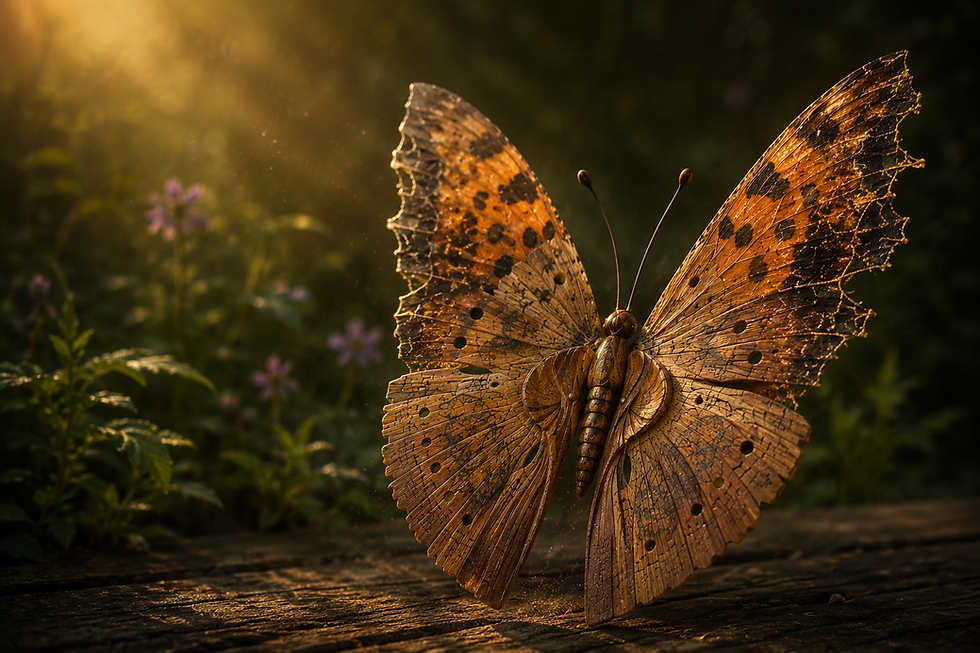
Turning Ashes into Beauty

Updated: 11 hours ago
A Field Note by Reena Adair
“The ashes may not be the end of the story.”
There are seasons when something changes so completely that all we can see at first is what was lost.
A relationship, a dream, a sense of belonging, or work we once believed in may leave behind what feels like ashes. We stand before the remains and wonder whether they still have a purpose.
I do not believe suffering becomes good simply because something meaningful eventually grows from it. Some things should not have happened. Finding beauty afterward does not excuse the harm, restore everything that was taken, or turn the fire into a blessing.
But the ashes may not be the end of the story.
What the Flowers Preserved
One of my artworks is called The Woman Who Was Still Gathering Flowers, although no woman appears in it.
The image contains what she gathered: Texas wildflowers pressed into stained glass.

The flowers preserve the happiness of gathering them - the color, freedom, and beauty of that moment. That joy was real. Whatever happened afterward cannot reach backward through time and make it untrue.
The glass carries a different part of the story. It is fractured, yet the flowers have become fused with it. Beauty and brokenness are no longer separate chapters that can be neatly divided. They exist within the same reality, held together by lines that reveal where the breaks occurred.
And light still passes through them.
The unseen woman is present through the act of gathering. We do not see her face or learn everything she endured. We know her by what she noticed and by the beauty she carried forward.
The most important word in the title is still. She was gathering flowers while her life was unfolding, before she knew how the memory would later feel or what the image would eventually become. Pain did not erase the happiness of that day. It became part of the same history, but it did not consume everything that history contained.
Looking at the finished artwork, I began to understand that preservation does not always mean keeping something in its original form. Sometimes what survives must take on a different shape.
The Work That Changed Shape
I had already experienced that kind of change in my creative work. Farmstracts did not appear from nowhere. It grew from questions that brought an earlier project to a stop.
Fabstracts began as an exploration of digital imagery and abstraction. I created work that mattered to me, but concerns about ownership and the sources of some of the images eventually led me to step away.
For a time, that looked like an ending. Instead, it changed the foundation on which I wanted to build.
I began creating from photographs I had taken myself - gardens, animals, old vehicles, rural roads, weathered buildings, and unexpected things I encountered in Arkansas. The questions that interrupted Fabstracts helped me understand how deeply I wanted my work to remain connected to something I had genuinely witnessed.
That change became part of Farmstracts.
Fabstracts did not continue in the form I first imagined, but neither was it wasted. It taught me what I wanted to protect and what kind of responsibility I wanted to carry as an artist. Something from the earlier work survived and found its place inside what came next.
That experience changed the way I think about my other unfinished projects. A project may become quiet because its time has not arrived, because its direction needs to change, or because it has already planted something elsewhere.
I cannot always tell which one is happening.
A pause is not necessarily an ending. Sometimes it is the space in which another form begins.
What the Quiet Made Room For
The past two years have been a quieter and more isolated season in my life. Some of that isolation may have been chosen, and some of it may not have been.
During that time, creating became one of the ways I remained attentive to God, to the world around me, and to the parts of myself that were still alive.
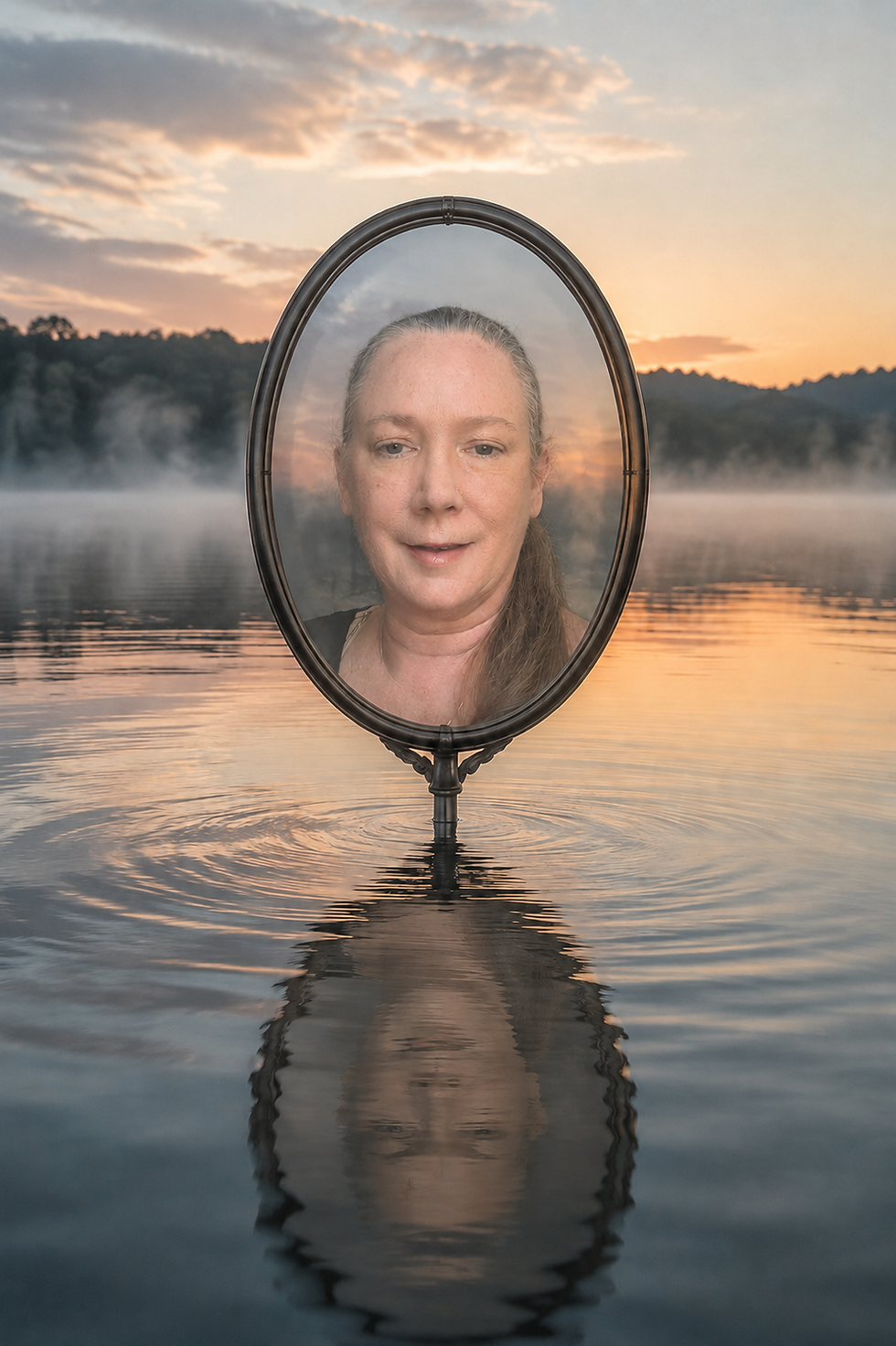
Much of my artwork begins with the desire to photograph something that cannot exist in front of a camera. In the opening image, I appear inside a mirror standing in a lake while the mirror and my face are reflected again in the water. I could not have taken that photograph as it appears. Digital tools allowed me to construct it, but the idea came from a real feeling: trying to stand outside my own life long enough to see who was looking back at me.
The quiet did not always feel purposeful while I was living inside it. Yet it made room for me to notice things I might once have passed without a second thought: light moving across a drainage ditch, the personality in an old hood ornament, memory gathering around an aging bridge, or wings suggested by the shape of a worn wooden fan.
These subjects did not arrive as finished ideas. Something caught my attention, and I stayed with it long enough to discover why.
I believe the Holy Spirit works through that willingness to pay attention. I still take the photograph, make the decisions, reject what feels wrong, and do the work. But I do not believe the impulse to see possibility everywhere belongs entirely to me. I receive it as a gift and try to use it faithfully.
A camera helps me preserve an encounter. Digital tools allow me to explore where the image might go. Neither one determines what matters enough to pursue. That begins in the relationship between what is before me, what I carry within me, and what may be revealed when I remain attentive.
Farmstracts has grown inside that relationship. It has given shape to a season that might otherwise have been defined only by isolation.
What Beauty Looks Like Now
Isaiah speaks of God giving “beauty for ashes.”
For a long time, I may have expected restoration to be unmistakable - something lost replaced by something visibly better. But when I think about beauty for ashes now, I have begun to understand that restoration does not always appear dressed in the world’s clothing.
In my own life, it has often arrived through the mundane, the overlooked, and quiet blessings placed before me while I was distracted by what I thought restoration should look like. If I measure it only by the world’s idea of success, I may miss what God has already restored.
Restoration can be much quieter than that.
It can be purpose returning after confusion, the courage to begin something without knowing where it will lead, or the discovery that an old gift is still alive and asking to be used.
Sometimes I can see the beauty of that restoration in a finished artwork. Sometimes I see it in an unfinished project I have not discarded. Sometimes it is simply the ability to notice color again.
I want the work I create to bear witness to that - not because my story has reached a perfect conclusion, but because it has not. I am still living inside it. I do not know what every loss, unanswered question, or waiting project will become, and I do not need to force each one into a lesson before its purpose is clear.
What appears finished to me may not be finished in God’s hands.
The Woman Who Was Still Gathering Flowers does not show someone who escaped the fire untouched. It preserves the happiness she experienced before beauty and brokenness became fused into one history.
The glass carries the fractures, but it also carries the light.
The flowers remain.
And by the grace of God, so does the woman who gathered them.