Who Is the Artist When AI Enters the Picture?

Updated: 11 hours ago

“You didn’t make that. AI did.”
That accusation follows almost anyone who creates with generative artificial intelligence. Sometimes it is a question. Other times it is a verdict: you typed a few words, pressed a button, and claimed the result as art.
I understand the suspicion. A polished image can appear in seconds, and the finished picture does not reveal whether the person behind it spent thirty seconds or thirty hours making decisions. But the argument becomes confused when every image involving AI is treated as though it were made in exactly the same way.
The better question is: What did the human being contribute?
Why Artists Object
Artists have legitimate reasons to be angry. Many believe their copyrighted work was used to train commercial systems without permission, credit, or compensation. They worry that businesses will replace paid illustrators, photographers, and designers with inexpensive generated content. They see enormous quantities of generic imagery entering spaces where working artists already struggle to be seen.
Competition raises another concern. If AI-assisted work is entered into a traditional painting or photography category without disclosure, the participants may not be competing under the same expectations. These objections concern consent, livelihood, fairness, and honesty. They should not be dismissed as fear of something new.
At the same time, the label “AI art” is too broad to describe what actually happened. It can mean accepting the first result from a casual request. It can also mean beginning with original material and developing it through sustained human direction, criticism, and selection. Those processes are not equivalent.
Where My Work Begins
Farmstracts begins in the physical world. I photograph gardens, animals, old vehicles, rural roads, small towns, buildings, and overlooked objects. Something catches my attention, and I decide where to stand, what to include, and when to press the shutter.
Later, I return to the photograph and consider what else it might hold. Sometimes I want to intensify an atmosphere already present. Sometimes the scene suggests an entirely different world. AI-assisted tools can help me explore those possibilities, but exploration is not the same as surrendering the work.
Midnight at Janssen Park shows why that distinction matters.
From a Daytime Photograph to Midnight at Janssen Park
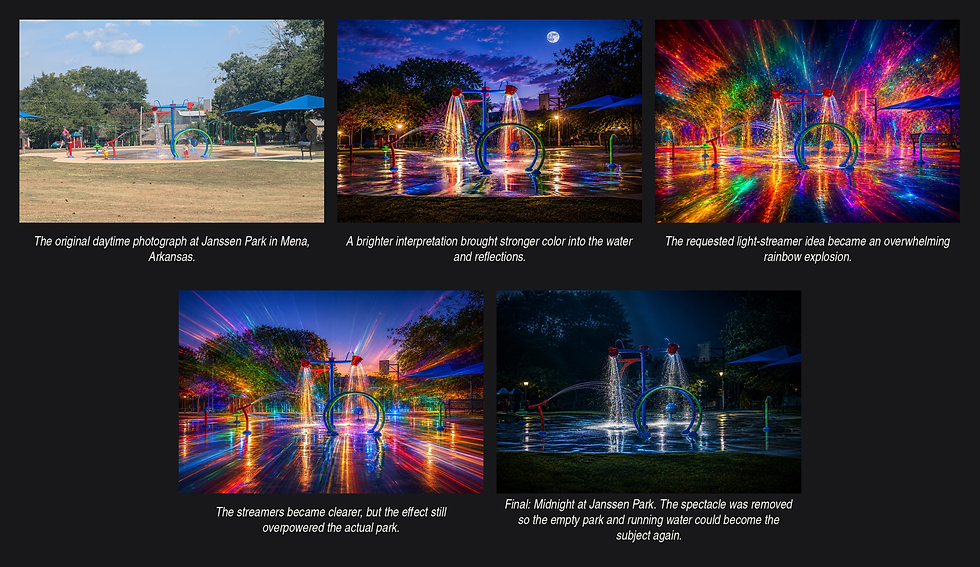
I took the original photograph at Janssen Park in Mena, Arkansas, while attending the 2026 Queen Wilhelmina Rod Run. It was an ordinary daytime scene, with children playing in the splash pad and adults nearby. Afterward, I began wondering what the park would look like at night if the water were still running but nobody was there.
I also had a particular lighting effect in mind. In movies and long-exposure photographs, moving traffic can leave separate red, yellow, and green trails. I wanted a restrained version of that idea moving through the water and reflecting across the wet surface. I did not want the park turned into a psychedelic rainbow.
Communicating that distinction took several attempts.
Where Authorship Becomes Visible
This sequence does not prove that every generated image is art, or that everyone who uses an image generator is practicing as an artist. If I entered a casual request, accepted the first result, and claimed that I had consciously authored every visual detail, the critics would have a point.
It also would be inaccurate to say that the tool simply obeyed me like a paintbrush. The failed versions show otherwise. My idea had to be clarified, evaluated, restrained, and sometimes rescued from an attractive misunderstanding.
The human contribution in this example is visible in the original photograph, the imagined nighttime premise, the specific lighting concept, the criticism of each interpretation, and the decision to choose a quieter final image over more dazzling alternatives. I do not need to reveal a reproducible technical recipe to show those decisions honestly.
What I Owe the Viewer
If I want viewers to take my work seriously, I owe them an accurate account of what it is. I should not present a transformed scene as untouched documentary photography. I should identify my original photography and acknowledge when generative tools materially influenced the finished image. When another person’s artwork, property, or likeness is involved, permission and credit must also be considered.
I describe Farmstracts as original photography transformed through human direction and AI-assisted creative tools. I have also called it mixed media, mixed brains, and AI. Both descriptions acknowledge the technology without allowing it to erase the person who made the original photograph and shaped the finished work.
So, Who Is the Artist?
A camera can record a scene, software can alter it, and AI can produce visual possibilities. None of those tools supplies the reason the work exists.
When AI enters the picture, the artist does not automatically disappear. But using AI does not automatically make someone an artist either. The answer depends on what the person brought to the work and whether that person is willing to be honest about the process and responsible for the result.
If you responded to an image before knowing how it was made, would learning that AI was involved change what you saw - or only what you believed about the person who made it?