
The Art Behind the Website I Almost Took for Granted


When I began building Farmstracts, I thought I was creating a place to display my artwork and tell the stories behind it.
I had photographs, finished pieces, four collections and a growing body of Field Notes. I knew what I wanted the experience to feel like: four worlds, one light. A place where someone might step away from the noise, stop long enough to look closer and discover something that was there all along.
An escape into reality.
I understood the vision. What I did not understand was how much invisible work it would take to make that vision function on a screen.
From the outside, a website can appear deceptively simple. There is a photograph, a title, a menu and something to click. When everything works, we move through it without thinking about who placed those elements there or how many decisions were required to make the experience feel natural.
We usually notice websites when they do not work.
I certainly noticed mine.
Building Farmstracts with the Wix Harmony editor has not always felt harmonious. I have watched elements behave differently on a phone than they do on a desktop. I have corrected something in one place only to discover a new problem somewhere else. I have dealt with slow-loading pages, labels I could not select, layouts that shifted and features that disappeared, only to return after a refresh.
There were moments when the website and I seemed to be involved in a private argument - and the website was winning.
Yet the longer I worked through those frustrations, the more I began to see what had previously been invisible to me. I started with an appreciation for websites that looked beautiful. I came away with respect for the people who make them work.
A builder must decide where the eye should land first, whether the words can be read against the background and what will happen when a visitor touches a phone instead of clicking with a mouse. The same page must function on a monitor, laptop, tablet and small screen. Images must remain beautiful without taking forever to load. Navigation must be visible without overpowering the content. Every font, button, margin, transition and empty space participates in the experience.
What looks like a page is actually a meeting place for artistry, engineering, psychology and storytelling. It is also a form of digital hospitality. Website builders prepare places for people who have not arrived yet, anticipating what they might need, what could confuse them and what might invite them to stay.
When that work is done exceptionally well, we may never think about it. The experience feels so natural that the labor behind it disappears.
That may be one of the highest compliments a website builder can receive.
It has also made me reconsider how quickly I judge the websites that frustrate me. The next time I struggle through the Social Security website or another government system that does not seem designed for the human being using it, I will probably still say that it is confusing. Usability matters, especially when people are trying to reach services that affect their lives.
But I may also stop and look closer.
Behind that difficult screen may be an outdated system, layers of regulation, security requirements and workers without enough authority, time, staffing or pay to repair what users blame them for. That does not excuse a broken experience, but it does make the machinery more human.
Every digital form, button and menu is a mechanical piece of our reality on the internet. Somewhere behind each piece are people trying to make it work.
Increasingly, they are working with artificial intelligence. Website platforms now use AI to generate text, suggest layouts, create sections, answer questions and attempt to correct problems. It became part of my construction process too.
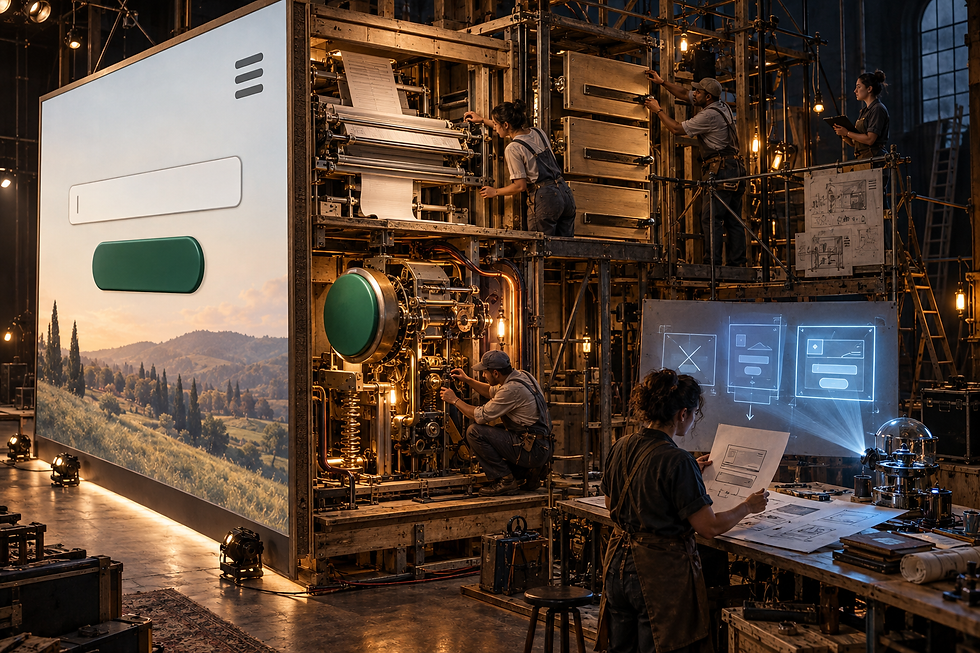
AI helped me navigate a technical world in which I have no formal training. It translated unfamiliar language, helped me describe what I was seeing and helped determine whether the ideas I brought to it could actually be built. When an idea was possible, it helped me find a path toward implementing it.
The possibilities did not begin with AI. They began with my eyes, my questions and my willingness to keep asking, “Can we do this?”
I am glad I took the time to build this website myself. I could have paid someone thousands of dollars to create it, and there would have been real value in the knowledge and experience I was paying for. Part of that process, however, would still have involved learning how to use what had been built. Websites need new content, updates and repairs. Unless I intended to pay someone every time Farmstracts needed to change, I was going to have to understand some of the machinery behind it.
Instead of using AI to avoid learning, I used it to learn enough to build, question, correct and eventually maintain my own website.
That does not make me an expert. What I learned showed me how much I do not know, which is precisely why I now respect professional website builders so much.
Website building is not my passion. Farmstracts is.
AI did not spare me from thinking. It required me to think more precisely. It could still offer an answer with complete confidence and misunderstand what was happening on the page. I had to compare its answers with the evidence on the screen and say, “No, that is not what I meant.”
Like most powerful tools, AI has more than one edge. It can become a substitute for thought, or it can lead us into knowledge that once felt inaccessible. The difference lies partly in what we ask it to do for us.
I did not ask AI to imagine Farmstracts in my place. I asked it to help bring what I had already imagined into view.
Assistance is not authorship. The vision, judgment and responsibility remain human.
In the beginning, I imagined the Farmstracts website as the wall where I would hang my artwork. Somewhere along the way, I realized the wall was part of the artwork. The way visitors enter, move among the four worlds and encounter the stories changes how the work is understood.
The website is not merely holding Farmstracts. It is participating in its story.
And the story would never begin if I refused to open the door.
I could continue improving this website forever. There will always be another adjustment, another page to refine and another problem to solve. If perfection becomes the condition for publishing, I can remain safely occupied with making Farmstracts better without ever allowing Farmstracts to do what it was made to do.
So I am choosing to publish it without perfection.

That does not mean I am finished caring for it. I expect the website to change as I learn. I welcome thoughtful feedback about how it responds to the people using it—particularly if something is difficult to read, slow to load, confusing to navigate or not functioning properly on a particular screen. The vision will remain mine, but I want the doorway to work for the people invited through it.
The difficulties I experienced with Harmony are real. Some of its limitations should be corrected, and I would still gladly trade certain opportunities for personal growth for a button that simply does what it is supposed to do.
Gratitude does not require dishonesty.
Faith has taught me that difficulty is not always wasted. Sometimes it means continuing before every answer is visible. Sometimes it means trusting that the work can serve its purpose before every imperfection has been removed. Sometimes faith is not another thing to say.
It is opening the door.
Farmstracts was built to stop and look closer—to find beauty amid the ordinary, the overlooked and sometimes the broken. Building the website required me to practice that mission before I could invite anyone else into it.
I looked at resistance and found respect.
I looked at the machinery and found people.
I looked at an imperfect website and decided it was still worthy of being seen.
The doorway is not perfect. Neither is the person who built it.
But the light is on.
Come in.


